- Punch everyone leaving a large carbon footprint.
- Take a bath in women instead of water.
- Email or call your congressperson to urge them to renew the clean energy tax incentives. With the temporarily depressed price for oil, and the dipping economy drying up the investment for new green technologies, especially in venture capital, there is a dangerous risk that alternative energy will suffer a major delay in seeing widespread use. The election is just days away, and if enough people call their congresspeople, they will have no choice but to include energy in their platforms. Go to http://www.wecansolveit.org/ for more things you can do.
Wednesday, October 22, 2008
Three Ways to Go Green

Saturday, October 18, 2008
Firewalls
"Connecting your laptop to the local coffee shop's Wi-Fi without a good firewall and thinking you're secure is like using a condom with thousands of holes in it and calling it safe sex."
Make sure your Windows condom doesn't leak.
Make sure your Windows condom doesn't leak.
Wednesday, August 20, 2008
The Olympics
The Olympics are the only thing I can watch for hours on end besides Star Trek. There are 28 sports, subdivided into approximately 300 events. It's a three-week festival of the greatest athletes on Earth engaging in (what should be) friendly competition. However, a few things have marred this Olympics for me.
- The NBC coverage has been abysmal. There are 28 sports. Yet it seems like all I see is swimming, gymnastics, track & field, volleyball, and the occasional diving event or basketball game. Of course, to be broadcast at all, the event must have an American with a chance of making it to the finals. Where are the world champion fencing, or field hockey, or soccer, or judo, or handball, or sailing, or table tennis, or trampoline, or any of the cycling events?
- The live commentators talk about non-American athletes like soulless automata whose only goal is to stop the glorious and pure American athletes from grabbing their obviously deserved golds. Don't get me wrong. I'm cheering for the US, but like many, I watch the Olympics to witness the best in the world in action, whether or not that be an American. More than a few are very annoyed.
- Yes, the Chinese gymnasts are under 16.
- Watching any of the good videos online at nbcolympics.com requires Microsoft Silverlight 2.0 as well as verification of cable or satellite subscription. Of course, you can just pretend to have a cable subscription, but using Silverlight instead of Flash was a poor decision, motivated by business deals rather than technology and usability. It might earn Microsoft yet another large anti-trust violation, but of course, not before it weasels its way around Flash and displaces it.
- The IOC apparently doesn't like it when people watch the Olympics. They have sent numerous takedown notices to blogs, YouTube, torrent sites, and other media hubs that have been hosting Olympic content. It will be a sad day when the IOC begins to stand for censorship.
Wednesday, July 16, 2008
21
I'm finally 21! Thanks to all those friends who made the day awesome-- Jessica for calling right at midnight (and sending frequent updates on the 14th about how many minutes there were left to my birthday); Natasha, Catherine, Susan for appearing at my room at 12:04 with my first legal drinks and lots of friendly peer pressure; Ari, Patrick, Brandon, Ben, and others at Palantir; my CS106 sectionees that noticed it was my birthday during IGs today at the LaIR; my parents for the amusing gifts as well as money for a new fridge; the friends who wished me a happy birthday over Facebook or over the phone; the people coming to dinner tomorrow; and of course, Wilbur summer staff (Larissa, Jiahui, Marian, Victoria, Sawyer, Mattie, Isaac, and Tim) for the rich, chocolaty Prolific Oven cake decorated with 21 candles at staff bonding.
I'm past the last hurdle before turning 30...
I'm past the last hurdle before turning 30...
Wednesday, July 9, 2008
Mercedes To Ditch Gas Cars
Hot off the presses, and slashdotted, Mercedes to stop producing petroleum-burning vehicles by 2015. This would be quite something if they succeed, and perhaps a much-needed shock to the automotive industry as a whole if they do publicly commit more money to the effort.
Thursday, July 3, 2008
Why I Don't Have a Text Message Plan
Whoever was the original brainchild behind marketing SMS as a premium "feature" is both a genius and a idiot. Genius because it is now an $80 billion plus industry. Idiot because transferring text should really not cost that much. According to a Techcrunch article, it costs $1310 per MB of text messaging. This assuming 160 byte messages and the 20 cent charge on the 3G iPhones if you don't have a plan. According to AT&T's own 3G specs, the network can provide up to 128kbps in a moving vehicle. So that's 160*8=1.28kbits for 20 cents, while you can download 10 times that amount in a single second. There's something terribly wrong. I believe it will only be time before SMS becomes free after a killer phone messaging web app comes along with free messaging that will dethrone the large networks and their monopoly on SMS.
Friday, June 27, 2008
Keyboard Shortcutting
If you're on your computer or online a few hours each day, and you go to a wide variety of web sites, or use lots of different programs, you have probably realized that using the mouse is a slow endeavor, and that keyboard shortcuts rock.
Here are two that rock the hardest, in my opinion.
1. Launchy (http://www.launchy.net)

Launchy is a text launcher that will revolutionize the way you use your computer. After installing, just press Alt-Space to pop up the launcher, and start typing the name of the program you want to launch, or even non-continuous letters of the program you would like to launch. Then, select from the list using the arrow keys the one that matches. Launchy quickly learns the programs you launch the most, so after a day or two, you'll be amazing everyone with your program-launching skills.
2. Firefox keywords
What if you can search something on google by typing "g something" on your web browser? Or search Wikipedia by typing "wp something"? Or UrbanDictionary, or YouTube search, or hundreds of other possibilities? Well, here's a quick guide on how to set those address bar searches up in Firefox.
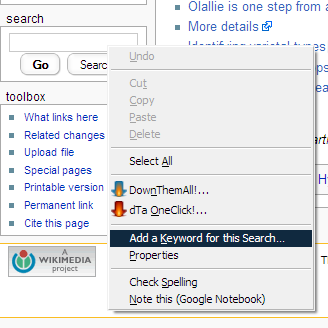
A. Go the the page with the search box. I used Wikipedia below as an example. Then, right click in the search field, and click "Add a Keyword for this Search..."
B.
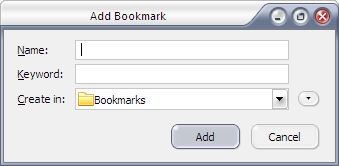
The following dialog should pop up:
C.
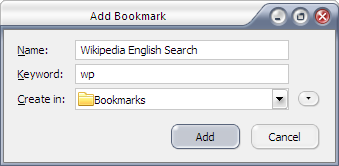
Type in a name for your bookmark, and a short, easy to remember keyword with which you can use your search. In my Wikipedia example, I used "wp".
D.
Then, in the address bar, just type "[your keyword] [your search]" and you're good to go! (Hint: to quickly go the the address bar, just press F6!)


Here are two that rock the hardest, in my opinion.
1. Launchy (http://www.launchy.net)

Launchy is a text launcher that will revolutionize the way you use your computer. After installing, just press Alt-Space to pop up the launcher, and start typing the name of the program you want to launch, or even non-continuous letters of the program you would like to launch. Then, select from the list using the arrow keys the one that matches. Launchy quickly learns the programs you launch the most, so after a day or two, you'll be amazing everyone with your program-launching skills.
2. Firefox keywords
What if you can search something on google by typing "g something" on your web browser? Or search Wikipedia by typing "wp something"? Or UrbanDictionary, or YouTube search, or hundreds of other possibilities? Well, here's a quick guide on how to set those address bar searches up in Firefox.
A. Go the the page with the search box. I used Wikipedia below as an example. Then, right click in the search field, and click "Add a Keyword for this Search..."

B.
The following dialog should pop up:

C.
Type in a name for your bookmark, and a short, easy to remember keyword with which you can use your search. In my Wikipedia example, I used "wp".

D.
Then, in the address bar, just type "[your keyword] [your search]" and you're good to go! (Hint: to quickly go the the address bar, just press F6!)

Sunday, June 8, 2008
Private Data
My private information may be public now. Shit.
If you get offers to buy my social security number from some sketchy source, please let me know. kthxbai.
If you get offers to buy my social security number from some sketchy source, please let me know. kthxbai.
Friday, June 6, 2008
The RIAA is Suing My Printer

There is an interesting study out by the University of Washington's Computer Science department revealing flaws in the detection of copyright infringers online. In the study, it was found that enforcement agencies sometimes used merely the fact that an IP address was seen in connection with a certain file online in implicating a user, without verification that the owner of the IP address did actually download anything, or that the owner of the IP is even a person. With IP spoofing tactics, they managed, hilariously, to get three printers in the CS department to receive DMCA takedown complaints from the MPAA. Is this result likely to get noticed in the next wave of countersuits against the RIAA and MPAA? Probably. Are universities going to change their policies because of this? No comment.
See the official page for the paper, an FAQ, and more details.
(Image courtesy of the Washington University CS Department.)
Tuesday, June 3, 2008
Personal References: Toward a Better System
Here's a hypothetical situation that is all too real: A employee has in impeccable record on paper--graduated from Stanford, interned at all the big-name companies, years of experience in key projects at well-known places, both big and small, and a very smooth interviewer, and seems extremely engaged and excited about the job. S/he is hired, and turns out to be a total slacker. He voluntarily leaves 6 months later, and takes a cushy post at another company, with good references from his two friends he made while in the current company. Lather, rinse, repeat.
This is really something to look at in the hiring process. If a company were to spend tens of thousands of dollars on some new servers, the people in IT would probably look into reviews of the servers in forums, written by current and past users, and more than just one or two firsthand accounts of how well the server functions. The IT people probably would not base the decision on the marketing brochures from the selling company and a cursory demo of the platform.
So why is hiring people any different? Hiring a qualified engineer, business development person, or marketer in the Valley will probably cost you at the minimum $70,000 a year, and can often break $120,000 a year, and yet many hiring managers never make a call to even a candidate's listed references, much less random co-workers. This problem is even more apparent in positions that are temporary or have a short hiring process, when there isn't enough time to check references, or when there isn't a good system for contacting past references.
Stanford's Residential Education (ResEd) system is a good example of this. Residential staff, especially freshman residential staff plays a huge role in shaping the lives of all Stanford undergraduates, and upperclassmen who have already been staff for a year usually are preferred over those who have not, yet there isn't a set system in place for references. The staff member's residents over the past year would be a perfect source of information about the candidate, yet there is a stigma against contacting them, resulting in bad candidates being rehired year after year.
When a draft of a scientific paper is sent to a prestigious journal for publication, the authors (and eventual readers or the journal) expect that the article will undergo double-blind peer review by several other scholars in their field. This ensures that the final published article will be legitimate and have at least a backing of several people in the field. While double-blind reference calling may be difficult, why is there such a stigma against calling random people with which the candidate interacts? The standard system of references is inherently flawed because the candidate provides the names. It's as if you were to ask Microsoft if Windows is secure.
This is really something to look at in the hiring process. If a company were to spend tens of thousands of dollars on some new servers, the people in IT would probably look into reviews of the servers in forums, written by current and past users, and more than just one or two firsthand accounts of how well the server functions. The IT people probably would not base the decision on the marketing brochures from the selling company and a cursory demo of the platform.
So why is hiring people any different? Hiring a qualified engineer, business development person, or marketer in the Valley will probably cost you at the minimum $70,000 a year, and can often break $120,000 a year, and yet many hiring managers never make a call to even a candidate's listed references, much less random co-workers. This problem is even more apparent in positions that are temporary or have a short hiring process, when there isn't enough time to check references, or when there isn't a good system for contacting past references.
Stanford's Residential Education (ResEd) system is a good example of this. Residential staff, especially freshman residential staff plays a huge role in shaping the lives of all Stanford undergraduates, and upperclassmen who have already been staff for a year usually are preferred over those who have not, yet there isn't a set system in place for references. The staff member's residents over the past year would be a perfect source of information about the candidate, yet there is a stigma against contacting them, resulting in bad candidates being rehired year after year.
When a draft of a scientific paper is sent to a prestigious journal for publication, the authors (and eventual readers or the journal) expect that the article will undergo double-blind peer review by several other scholars in their field. This ensures that the final published article will be legitimate and have at least a backing of several people in the field. While double-blind reference calling may be difficult, why is there such a stigma against calling random people with which the candidate interacts? The standard system of references is inherently flawed because the candidate provides the names. It's as if you were to ask Microsoft if Windows is secure.
Subscribe to:
Posts (Atom)

 Posts
Posts


